
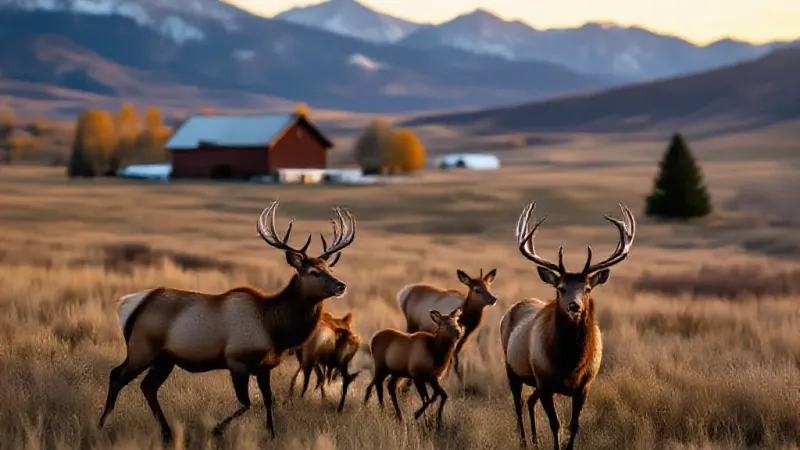
A ranch in Colorado is pioneering a new approach to land stewardship by becoming the first in the nation to establish an elk migration agreement. Eagle Rock Ranch, located near Tarryall, has implemented a pact that compensates ranchers for providing migratory pathways for elk through private land, creating a market solution for conservation.
This five-year, privately funded project is a collaboration between the Colorado Cattlemen’s Agricultural Land Trust and the Property and Environment Research Center (PERC). Erin Michalski, who helps her parents, Dave and Jeannie Gottenborg, run Eagle Rock Ranch, emphasized that ranchers are significant advocates for the land. Michalski, who transitioned from a banking career to ranching, explained that the agreement allows the family to profit from conservation efforts.
The core of the agreement involves managing "laydown fencing." This system uses regular T-posts, but the barbed wire in certain sections is attached to three-inch-diameter wooden posts. These wooden posts can be secured with fencing stays against the T-posts when needed, but can also be laid down when not in use. Michalski described this as laying the fence upward, and then when it's not needed, undoing the stays so "that whole fence can literally lay on its side." This method enables easier migratory paths for elk, antelope, and deer, preventing them from tearing down fences.
During the spring, fall, and winter, when the ranch's pastures are not actively grazed by cattle, the fencing is laid down, allowing elk to utilize ungrazed areas. In the summer months, when pastures are needed for livestock, the fences are put back up. Michalski noted that this system requires much less work than constantly repairing fences damaged by elk.
Michalski credits her father, Dave Gottenborg, for driving this innovative approach. She stated, "We needed to figure out a way to work with them and not against them." This philosophy guides their land management, aiming to welcome elk while still enabling ranching activities. Dave and Jeannie Gottenborg purchased Eagle Rock Ranch in Park County in 2012, setting out to restore what they described as a "wounded landscape."
Beyond the elk migration agreement, the Gottenborg family has implemented a range of conservation practices. They have replanted willows along riverbanks to help preserve them, created miles of improved fish habitat for trout by digging deeper ponds, adding shade elements, rocks, and fish ladders, and engaged in extensive soil health restoration. Their comprehensive efforts were recognized when Eagle Rock Ranch won the Colorado Leopold Conservation Award earlier this year. The family received the $10,000 award in June at the Colorado Cattlemen’s Association annual convention, an honor that was also featured at the Colorado State Fair.
Michalski also manages the ranch’s direct-to-consumer sales of all-natural Black Angus beef. She observed that word about their conservation-focused ranching methods is spreading, with more ranchers in their valley beginning to keep their fences down during elk migration periods and becoming more aware of how to cohabitate with wildlife.
PERC is actively working to promote market-based conservation solutions nationally, helping ranchers and farmers align their practices with environmental stewardship incentives. Michalski indicated that Eagle Rock Ranch is now more profitable than when they had to repair fences annually. Colorado's elk population, once as low as 40,000 across North America in the 1900s, has now grown to 280,000, the largest in the world. Michalski said previous ranch owners at their property had used air horns to deter elk, but the Gottenborgs decided to embrace coexistence, recognizing that "the elk have been at our ranch long before we were."