
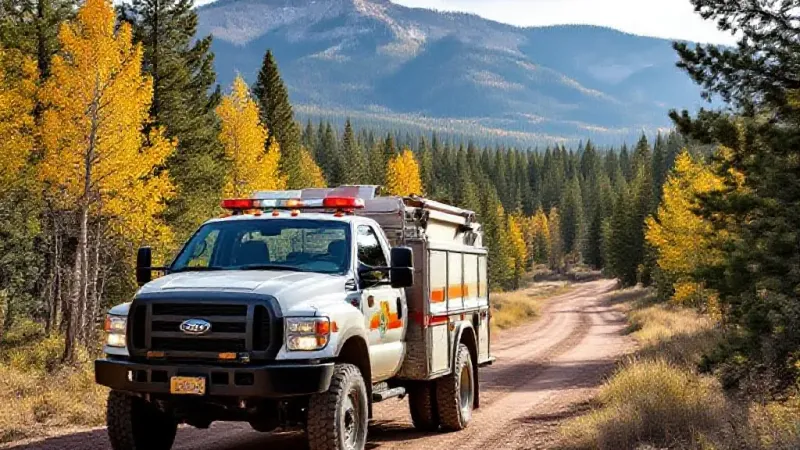
Colorado-based businesses saw $189 million less in federal contract work on public lands last year, marking a nearly one-third decline from the previous year. This reduction, primarily from the U.S. Forest Service and land management agencies within the U.S. Department of Interior, has impacted small businesses and rural communities across the state, according to a new report.
The analysis, compiled by Hawk Eye Strategies, a national policy and tribal consulting group, and Prospect Partners, LLC, a Washington, D.C.-based firm, examined publicly available federal contracting data from USASpending.gov. Andrea Delgado, founder of Hawk Eye Strategies, stated that the cuts raise questions about the methodology behind them, particularly in a state like Colorado with "some of the most visited public lands in the nation."
The report connects this significant reduction in contract spending to staff cuts implemented by President Donald Trump’s administration. Thousands of staff were slashed across federal land management agencies in the first weeks of his second term in the spring of 2025. This action stemmed from an executive order issued on February 11, 2025, to eliminate "waste, bloat and insularity" and was carried out by the now-defunct Department of Government Efficiency (DOGE). Colorado was particularly hard hit, losing more public lands staff than any other state, with approximately 1,750 jobs cut—about one-quarter of its land management staff.
Understaffing at the Forest Service has been a longstanding concern on the Western Slope. According to Delgado, counties across Colorado’s mountain corridor, including Grand, Summit, Eagle, Routt, and Garfield counties, all lost federal public land staff last year, with some seeing up to 50% of their staff eliminated. While a few counties, such as Gilpin and Pitkin, did not lose public lands staff, the statewide impact was substantial.
Federal agencies contract with a variety of entities, including small businesses, large firms, nonprofits, research institutions, and state and local governments. This work covers crucial areas such as inspection and maintenance, wildfire mitigation, fire suppression, and scientific research. The report indicates that approximately 80% of federal contracting work goes to small businesses. Across Colorado, about 110 fewer contractors received federal government work last year compared to 2024.
Nationwide, federal contract spending related to public lands fell by $1.3 billion, or about 14%, decreasing from $9.1 billion in 2024 to $7.8 billion in 2025. Rural counties in Colorado and across the nation especially experienced a decline in net spending with local vendors, with one in five rural counties seeing net spending hit zero in 2025.
Specific categories of contract work saw steep declines. Nationwide, federal land management agencies spent 36% less on scientific studies and technical analysis, 35% less on architecture, engineering, and professional services, and 29% less on information technology. These three categories also experienced the largest losses in Colorado.
Andrea Delgado expressed particular concern over cuts to wildfire suppression contracting. The report found that federal contracting related to fire suppression nationwide was down $255 million, a 10% drop, from 2024 to 2025. In Colorado specifically, federal contracting for wildfire suppression fell by $14 million in 2025. Hundreds of "red carded" employees, credentialed for wildfire assistance, also left federal land management agencies last year.
The Trump administration has attributed inflated federal staffing and contracting levels to one-time funding from the Inflation Reduction Act, passed under President Joe Biden’s administration, and insists that federal cuts have not impacted the nation’s wildfire response. However, the Hawk Eye Strategies analysis accounted for this factor, finding that the Inflation Reduction Act contributed only about one-quarter to one-third of the declines in federal public land contract spending in 2025.
Delgado, who previously served as a deputy regional forester in the Forest Service’s Rocky Mountain Region, stated that the combined impact of fewer federal employees to plan and oversee work and fewer outside firms to execute it raises questions about necessary preparedness and government responsiveness to fires. She also questioned how these reductions affect the visitor experience on Colorado's public lands. Colorado legislators, including Senator Michael Bennet, have voiced similar concerns regarding these cuts.