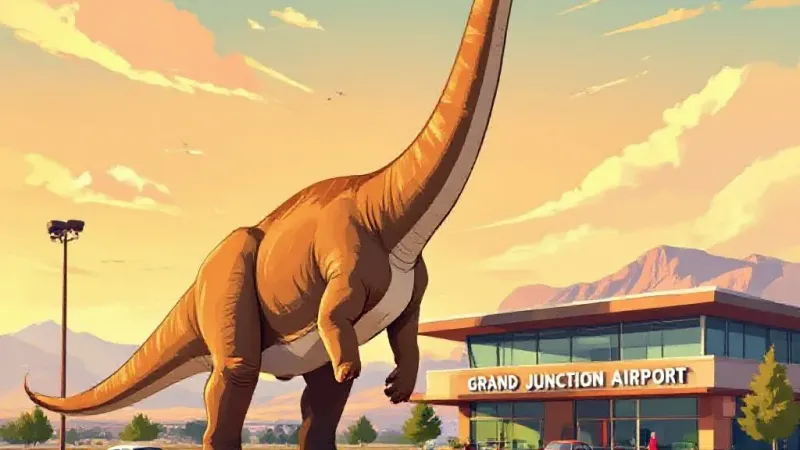
Colorado Governor Jared Polis visited the Grand Junction Regional Airport on Tuesday, Oct. 20, to celebrate the state's 150th anniversary and highlight the "Bring Our Brach Home" fundraising campaign. The Governor's office confirmed its support for the effort, which aims to install a 45-foot-tall replica of a brachiosaurus at the airport, commemorating a significant piece of local history. Polis made brief remarks next to the brachiosaurus skull, the only part of the fossil casting completed so far, acknowledging the project's unfinished state.
The "Bring Our Brach Home" project is focused on reconstructing a brachiosaurus fossil originally unearthed in the Grand Junction area. This initiative is one of several historically themed art installations statewide supported by the governor's office as Colorado marks its sesquicentennial. Governor Polis's office directed $10,000 toward the campaign, pushing organizers closer to their roughly $850,000 fundraising goal. Museums of Western Colorado Executive Director Shenna Hayden stated that fundraising has already reached approximately $250,000, an increase from the $185,000 reported just last month.
The planned 45-foot-tall brachiosaurus casting would be owned by the Museums of Western Colorado and placed on long-term loan to the Grand Junction Regional Airport. Airport officials consider the facility one of the few buildings in the valley large enough to house such a specimen. The project is tentatively scheduled for completion in 2028, with organizers hoping to secure the necessary funds by the end of 2026. Governor Polis emphasized the importance of community effort, stating, "we all need to come together to make sure it’s a body as well as a head" during his visit, and pledged to raise awareness for the project on the Front Range.
The decision to install a brachiosaurus replica at the airport is an homage to the first brachiosaurus fossil ever discovered, found at a dig site in what is now the Redlands area of Grand Junction. Paleontologist Elmer S. Riggs unearthed this specimen in the early 1900s. Although the original fossil was shipped to Chicago’s Field Museum of Natural History shortly thereafter, its discovery became a key component of the Western Slope’s cultural identity. At the time of its discovery, scientists believed it represented the largest land animal in Earth's history.
Airport officials express excitement about the iconic dinosaur's potential for "placemaking" for the airport's approximately 650,000 annual travelers. Grand Junction Regional Airport Authority Chair Linde Marshall affirmed the airport's commitment to local identity. Marshall said, "We believe deeply in branding this destination," adding, "Not only do we like to tell who we are, but we like to show who we are." Hayden, from the Museums of Western Colorado, also noted the positive impact of state-level support, confirming, "When you’re being supported by the governor and the state government, it is always a great way to really boost your project.”