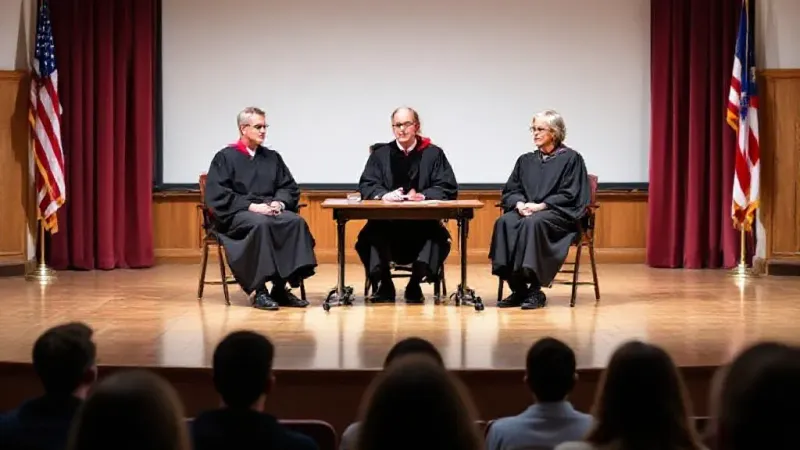
The Colorado Court of Appeals brought its judicial process directly to Grand Junction High School on Thursday, Oct. 8, hearing oral arguments for two cases in the school's auditorium. This visit was part of the state’s "Courts in the Community" program, which aims to provide high school students with a firsthand look at the judicial system and how disputes are resolved in a democratic society, according to a press release announcing the event. Judges Jerry Jones, Karl Schock, and Grant Sullivan presided over the arguments. Judge Sullivan serves as the appeals court’s liaison to the 21st Judicial District, which encompasses Mesa County.
The panel heard arguments for *Friends of Animals v. Colorado Parks and Wildlife* and *People of the State of Colorado v. Brandon Burns*. As is typical, the judges did not issue rulings immediately following the oral arguments.
The first case, *Friends of Animals v. Colorado Parks and Wildlife*, originated from a 2023 regulation enacted by Colorado Parks and Wildlife (CPW). This regulation restricted certain recreational activities in State Wildlife Areas to only those strictly related to hunting and fishing. Jennifer Best, Wildlife Law Program Director for Friends of Animals, explained that, for example, residents are generally not permitted to hike, camp, paddleboard, or bring dogs into these areas unless they are engaged in hunting or fishing. Friends of Animals argued that where CPW drew this line was "arbitrary and capricious." A district court in Denver had previously upheld these regulations, leading to the current appeal.
In her argument to the court, Best contended that CPW had abused its discretion by favoring hunting and fishing over other uses and failed to adequately consider public comments that requested the agency consider alternative uses. Friends of Animals further asserted in its opening brief that CPW dismissed more than 95% of comments submitted on the issue and did not include them in the official record, which they argued violated Colorado’s Administrative Procedure Act. Best stated that nearly 200 comments, mostly opposing the regulations, were submitted through EngageCPW, but were not considered part of the official record. Conversely, comments directly emailed to the CPW Commission were included in the official record, though these were significantly fewer in number than those on EngageCPW.
CPW attorney Christopher Stork responded to the court, stating that the agency was not obligated to include the EngageCPW comments as part of the official record. He noted that CPW had summarized these comments in a memo as part of the rulemaking process. The court observed that CPW’s website indicated EngageCPW comments would be reviewed by CPW staff. Stork acknowledged potential confusion regarding the form of this review but maintained that CPW had substantially complied with the Administrative Procedure Act. Best countered, noting that CPW had "already admitted the memo did not cover all the issues." She expressed concern to students after the argument that the case could establish a precedent allowing agencies to mislead the public during rulemaking, calling the exclusion of comments from the record "something I’ve never seen before."
The second case argued before the Court of Appeals was *People of the State of Colorado v. Brandon Burns*, which originated in El Paso County. According to the press release, this criminal case involved charges against the defendant after police stopped Burns, searched his car, and discovered drugs and a gun. On appeal, Burns argued that the trial court should have suppressed the drug evidence, claiming the police search violated his Fourth Amendment rights because it was not justified by an exception to the warrant requirement and was therefore unlawful.
Alyssa Akre, Burns’ attorney, detailed that police had searched Burns’ vehicle, found a gun, then paused the search for 10 minutes before continuing without what she argued was probable cause, subsequently finding the drugs. Akre emphasized that "The stop is what is extremely significant." She also argued that because officers were initially looking for a gun matching the description of the one they found in Burns’ car when they started the search, there was no justifiable reason to continue the search thereafter. The court noted that finding additional information or evidence during a pause in a search could strengthen probable cause, suggesting it could benefit law enforcement to pause and confirm probable cause before proceeding with a search.
Radhika Kattula, representing the prosecution in the appeal, argued that investigators typically do not cease their work once some evidence of a charge is found; they continue to investigate. Akre also mentioned that Burns had been acquitted of a felony menacing charge at his trial.
Following the oral arguments, the attorneys and judges engaged with Grand Junction High School students, answering questions about their career paths and judicial philosophies. The judges shared that despite having similar professional backgrounds — often starting as clerks for judges, moving into private practice, and then working as government attorneys before their appointment to the appeals court — there is no singular route to becoming a judge.