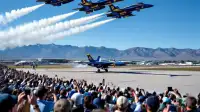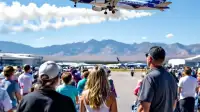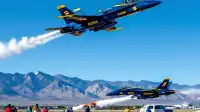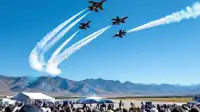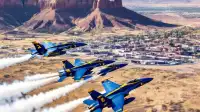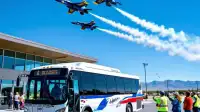
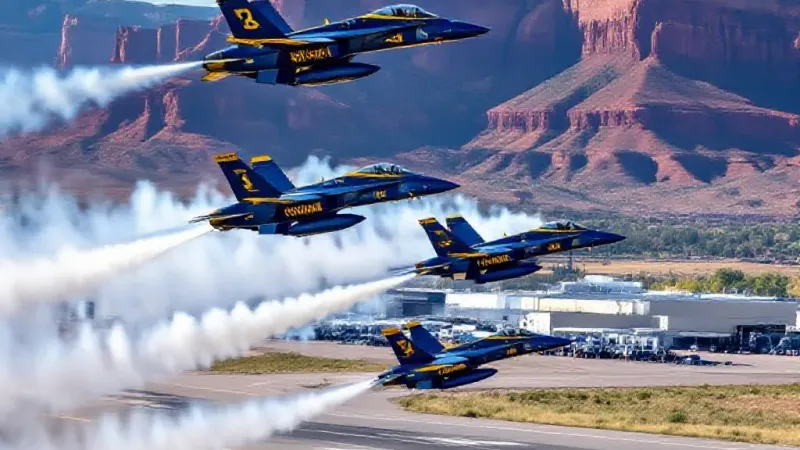
The U.S. Navy Blue Angels are set to perform at the Grand Junction Air Show this weekend, with flights scheduled for 3 p.m. on Saturday, Oct. 3, and Sunday, Oct. 4. The elite squadron prepared for their show on Wednesday, Sept. 30, conducting practice and passenger flights from the Grand Junction Regional Airport (GJT).
Capt. Adam Bryan, commanding officer of the Blue Angels, highlighted the specific challenges and unique aspects of performing in Grand Junction. According to Bryan, the local altitude will significantly impact their maneuvers. "Every single show site’s different, and this one will present its own unique challenges," Bryan stated. He explained that while the surrounding terrain is mostly flat, the elevation itself "will pretty dramatically impact our show." This challenge is one, Bryan noted, that every team member embraces. The higher altitude influences the approach to maneuvers, altering factors such as airspeed and G-forces pulled by the F/A-18 Super Hornets.
Bryan also praised the local scenery, noting that the "vista behind us here is going to provide an incredible backdrop for our show this weekend, unlike anything we do." He anticipated that the flights would be "really beautiful," offering fleeting moments for pilots to appreciate the view.
During their tightest formations, the Blue Angels' F/A-18s will fly with only "12 to 18 inches apart" in wingtip separation, Capt. Bryan confirmed. He described the proximity as so close that from the cockpit, a pilot could reach out and touch the wing of the adjacent aircraft, a feat requiring hundreds of practice flights.
The squadron also brought its C-130J cargo plane, known affectionately as "Fat Albert." Maj. Isaac Becker, a C-130J pilot, discussed the aircraft's unique performance characteristics and fan base. Becker observed that "Fat Albert" attracts a smaller, yet highly loyal, group of enthusiasts. He pointed out that air show attendees often anticipate the speed and agility of an F/A-18, not expecting a large, four-engine aircraft to perform maneuvers like flying straight up, executing a negative pushover, or flying close to the ground. Becker expressed pride in demonstrating the C-130J's tactical capabilities.
Becker also elaborated on the C-130J's performance challenges at higher elevations. He explained that a higher, warmer elevation poses "aerodynamic challenges," making the airplanes "sluggish" and reducing engine performance. This necessitates pilots to think significantly ahead of the aircraft, as, despite the plane's speed, "everything moves slower."
Regarding the distinct roles of the pilots, Becker likened the difference between flying an F/A-18 and a C-130J to different surgical specialties. He noted that while an F/A-18 pilot could likely perform basic controls in a C-130J already airborne, they could not execute its tactical employment or demo maneuvers. Similarly, F-18 pilots could not fly "Fat Albert" as its dedicated pilots do, emphasizing that both aircraft have distinct operational roles.
Among the crew is Grand Junction native Tristan Lafferty, an aviation structural mechanic for the Blue Angels. Lafferty described the experience of showcasing his work in his hometown as special. While his job is to display the team's hard work everywhere they go, having family and friends present to witness it makes the experience particularly meaningful, Lafferty said, adding that they find it "really cool."
Lieutenant Commander Ronny Hafeza piloted the number seven F/A-18 Super Hornet during a passenger flight on Sept. 30, which included former Colorado Rockies outfielder and current broadcaster Ryan Spilborghs.