The Grand Junction Air Show is set to return to the Grand Junction Regional Airport on October 3 and 4, featuring a flight demonstration from the U.S. Navy Blue Angels. However, organizers are emphasizing a significant change for attendees: there will be no public parking within nearly a mile of the airport grounds. This adjustment comes after the 2023 airshow experienced traffic backups on Horizon Drive for more than two hours.
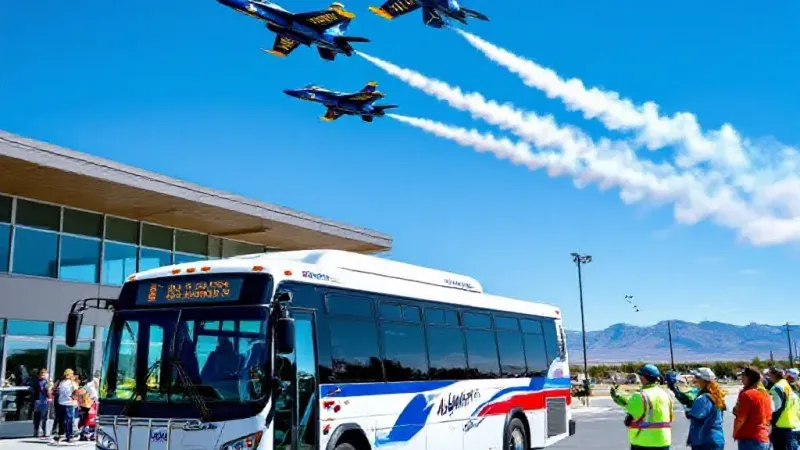
To address past traffic issues and ensure safety without disrupting airport business, all general admission ticket-buyers must now reserve space at one of several designated parking lots around Grand Junction. From these locations, attendees will be transported to the airport by one of 56 buses prepared for the weekend. Grand Junction Sports Commission Executive Director Ben Snyder stated, “The major thing we’ve really been working through is to ensure that there’s safety with this event, and that we’re not disrupting business for the airport.” He acknowledged that while the public might not “love the idea,” they are “coming around to it.”
Exceptions to the off-site parking rule include a small on-site lot for VIPs, sponsors, vendors, and airport and airshow staff, as well as some volunteers. The airport’s existing public parking lots will remain open exclusively for regular commercial flight customers. Grand Junction Regional Airport CEO Angela Padalecki noted that the airport’s 1,200 public parking spaces represent “one-tenth of what we would need for the airshow,” further underscoring the necessity of the new plan. To enforce the rule, an on-site tow truck, airport-imposed fines, and traffic control officers will be present to prevent airshow attendees from parking in airport lots. The goal of this shuttle system is to drastically reduce wait times on the road for attendees and prevent competition for parking spaces near the terminal, which are already often full.
The U.S. Navy Blue Angels are again the undisputed stars of the show, a particularly fortunate booking according to Grand Junction Air Show Board Co-Chair Julie Shafer. The squadron flies at only 33 public shows this year, and Shafer highlighted that Grand Junction’s selection was “especially fortunate” given the high volume of requests for the famous squadron, particularly for 2026, which marks the 250th year of American independence. Shafer credited the selection to Grand Junction’s history of “very efficient, very well-run airshows.” Beyond the Blue Angels, the program includes flight demonstrations by the F-16 Viper Demo Team, an L-39 fighter jet painted pink for breast cancer awareness, and antique aircraft like a “Tuskegee Airmen” Mustang and a TBM Bomber, both iconic machines from World War II. Aerobatic acts like the “Franklin Flying Circus” are also scheduled. Shafer expects this year’s event “easily could turn out to be one of the most attended” due to the number of acts.
The return of the local airshow, the first since 2023, is long-awaited by aviation enthusiasts, though the event has been held at irregular intervals since the first recorded flight in Grand Junction in 1912. Organizing such an event is a monumental task, requiring, on average, two years of planning. This year, the Grand Junction Sports Commission has taken on significant operational logistics, including parking, ticketing, food truck, and vendor coordination, as well as safety measures. Organizers also implemented behind-the-scenes security improvements. Shafer emphasized that the non-profit airshow would not be put on without a major jet team as part of the lineup, given the extensive work involved. General admission tickets are available on the airshow’s website, priced at $30 for adults in advance, $10 for children, and $15 for veterans. Tickets purchased at the gate for adults will increase to $40. Reserved seating tickets are available at higher price points, and VIP tickets are currently sold out.