
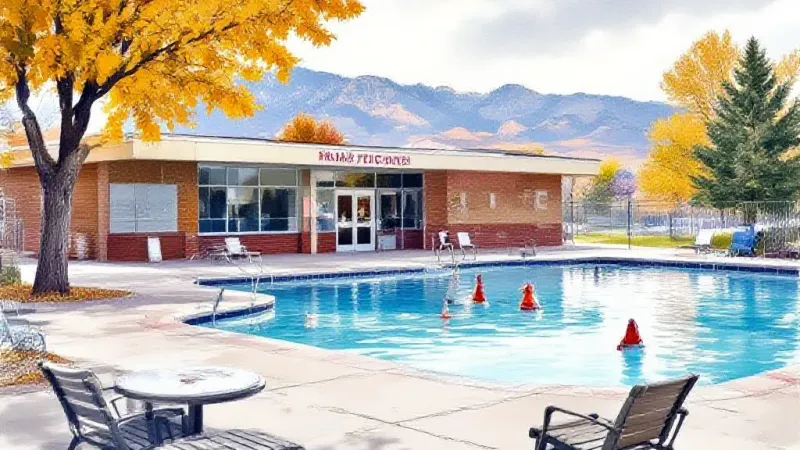
Grand Junction voters have rejected a proposed sales tax increase intended to fund repairs and ongoing operations for the Orchard Mesa Pool, effectively clearing the way for the long-troubled facility to close.
The ballot measure sought to raise Grand Junction’s municipal sales tax rate permanently by 0.04% and temporarily by an additional 0.03%. The proposal appeared exclusively on the ballots of city residents during the Tuesday, Nov. 3 election. Early tallying showed the measure trailing, with 13,069 votes in favor and 16,327 against as of 3 a.m. on Wednesday. Unofficial results from the Mesa County Clerk’s office recorded at 2:48 a.m. on Nov. 4 reflected the same margin, with roughly 4,000 ballots remaining to be counted as of late Wednesday morning.
In a press release issued Wednesday morning around 9 a.m., the City of Grand Junction confirmed that the failure of the measure means the facility will transition toward closure. Municipal officials noted that placing the question on the ballot gave residents an opportunity to decide on the necessary capital investments, adding that the city understands the closure will be difficult for community members who have used the pool for generations.
The decision brings an end to a intensive campaign waged by the Save Orchard Mesa Pool Committee. The grass-roots group spent three months organizing support through yard signs, door-to-door canvassing, campaign signs, and a decorated trailer outfitted with inflatable floaties to rally voters. Advocacy for the facility, which was built in 1983 and has since fallen into disrepair, had been ongoing for six to seven years, with supporters regularly attending Grand Junction City Council meetings to ask for solutions.
Mariann Taigman, co-founder of the Save Orchard Mesa Pool Committee, told a local news report on election night that advocates fought an uphill battle but did everything they could over their three-month campaign. Speaking from a watch party held at Gemini Beer Company before and after polls closed at 7 p.m., committee members expressed disappointment over the outcome. Taigman told a local news report that she harbored concerns regarding equity, questioning where low-income families will find affordable swimming lessons or venue options for events like birthday parties once the facility shuts down.
Pre-election data had previously signaled potential headwinds for the ballot measure. A city-commissioned community satisfaction survey conducted earlier in the year revealed that 43% of surveyed Grand Junction residents opposed taking on municipal debt and raising taxes to fix the pool, compared to 38% who supported the idea, while 19% expressed a neutral stance.
Advocates highlighted the Orchard Mesa Pool’s low admission fees and convenient location for residents living on the southwest side of the city. However, the recent opening of the city's new Community Recreation Center provided local residents with a modern aquatic venue alongside amenities such as exercise machines, basketball courts, billiards tables, and rock-climbing walls.
Usage data recently provided by the city to Colorado Public Radio indicates the Orchard Mesa Pool serves an average of 62 people per day. The ballot measure’s restriction to Grand Junction residents meant that many regular pool users were ineligible to cast a vote. During an Oct. 7 City Council meeting, pool user and advocate Jesse Miltier stated that out of a four-person senior water aerobics class at the facility, three were Mesa County residents who lived outside city limits and thus could not vote on the measure.
Despite the geographic voting restrictions, committee members campaigned across neighboring areas, including Palisade, Whitewater, and Glade Park, encouraging non-city residents to talk to friends living within Grand Junction city limits about supporting the pool. In a message posted to a community Facebook group on Wednesday afternoon, Taigman encouraged supporters to remain civically engaged by speaking with elected officials and writing letters to the editor to protect local resources.
The facility's operational future is tied to an agreement between the city and Mesa County Valley School District 51, which owns the building. The city's contract to manage operations expires at the end of this year. Municipal staff noted during an August meeting that the operating agreement was unlikely to be extended without secured repair funding, noting that city funds set aside in an escrow account could potentially be directed toward demolition if the partnership ends. District 51 Communications Director Callie Berkson stated in a text on Wednesday afternoon that the school district has not yet set a timeline or established next steps for the property.