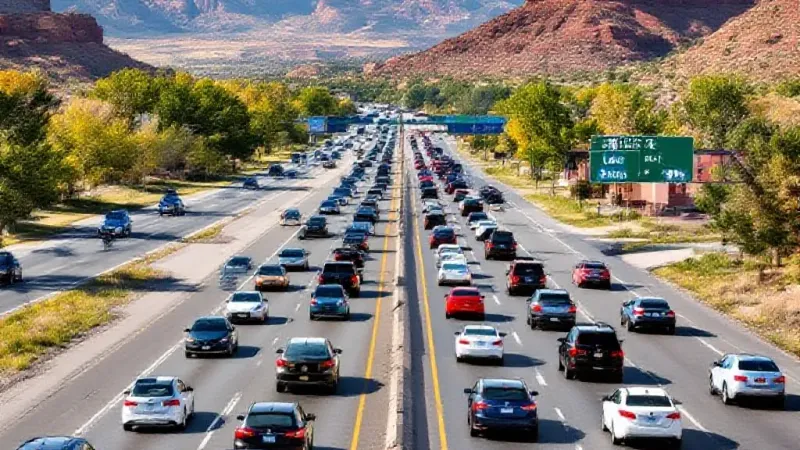
Traffic congestion on the Interstate 70 mountain corridor costs Colorado an estimated $2.25 billion annually, impacting businesses, tourism, and residents from Denver through Grand Junction, according to a new report.
The Metro Denver Economic Development Corporation released the 65-page report, which analyzed I-70’s role as "Colorado’s most critical east-west transportation corridor." This stretch of highway, connecting Denver to Grand Junction, functions simultaneously as a commuter route, a freight artery, and the backbone of the state’s tourism and outdoor recreation economy.
The cost of I-70 congestion has seen a significant increase over the past two decades. Shaun Brog, a senior economist who helped compile the report, stated that the cost has risen by an inflation-adjusted $777 million in the last 20 years, marking a 55% real increase. Brog attributed this rise partly to a 20% increase in traffic volume, driven by Colorado’s growing population, and also to the state's expanding gross domestic product (GDP) and average wages, which influence how the report estimates the cost of lost time for residents.
The report keys in on how I-70 congestion impacts three main sectors: businesses, tourism, and residents. For businesses, Brog noted that congestion affects worker productivity and overall business efficiency. The report estimates that if congestion-related factors have just a 0.5% impact on the state's GDP, it translates to a loss of $1.9 billion each year.
The state’s outdoor recreation industry also suffers direct impacts, as I-70 provides essential access to the mountains and numerous ski resorts, according to the report. The report suggests that even a 1% impact on tourism spending in the mountain resort region could result in approximately $47 million in lost annual tourism-related economic activity.
Colorado residents face longer commutes, reduced personal time, and higher vehicle and travel expenses. The report values the personal time lost to congestion at around $319 million annually. Additionally, vehicles experience more wear and tear when stuck in traffic compared to highway speeds, and drivers lose time for activities like skiing due to delays.
For the Western Slope, Brog highlighted how the I-70 corridor’s congestion directly impacts mountain communities. He explained that emergency services in these areas face a greater strain from more accidents and congestion, yet these communities do not necessarily receive more tax dollars if more people simply transit through their areas. This raises questions about how governments allocate resources to support these vital local services, as communities are asked to spend more without necessarily having the increased tax revenue to cover these costs, according to Brog.
Looking ahead, traffic on the I-70 corridor is only expected to worsen. Current estimates predict a 10% increase in overall traffic on I-70 in the next five years. Experts forecast increases of about 25% at the Eisenhower-Johnson Memorial Tunnels and 35% near Glenwood Springs over the next 25 years, though these figures could change if Colorado’s population growth slows. Brog emphasized that these projections for substantially increased vehicle-miles traveled and total vehicles will likely create "a pretty significant strain" on the corridor.
While the report does not offer specific solutions for improving congestion, Brog stated that its purpose is to provide crucial information for policymakers and businesses to consider as they address the corridor's future.