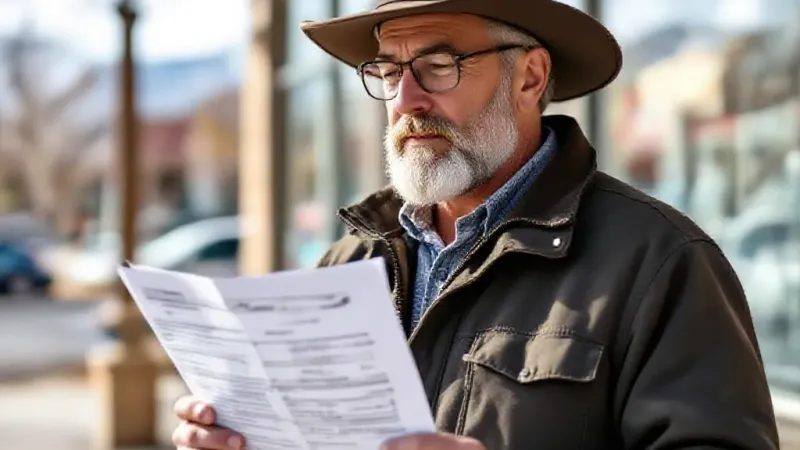
Grand Junction residents who have received their ballots in the mail this past week may have noticed their substantial size. Craig Hall, a local publisher and commentator, recently pointed out the ballot includes "45 different candidates, judges, initiatives or power and tax grabs" that seek to become Colorado law or influence state policymaking.
Hall noted that these ballot measures come on top of what he estimates as "500 to 1,000 new laws" passed legislatively in the past year. He believes the number of laws passed has "increased exponentially" since "Pontius Polis and the democrats" gained an "almost 'super-majority,'" asserting this has not benefited most voters or reduced state spending. Hall also raised concerns about the accuracy of voter rolls, mentioning a ballot sent to an individual who no longer resided at the address, and stated that "Jena refused to take off the rolls." He also referenced "Mesa County Martyr Tina Peters" and her "letters from LaVista Correctional Facility," but observed that she "never found an ounce of fraud."
According to Hall, an expansive ballot inherently leads to the expansion of government and an increase in local tax bills. He suggested that if an item appears on the ballot, it typically signifies either a tax increase or a proposal for the state to spend more money, which he claims invariably results in another tax increase on future ballots, often through "TABOR workaround[s]."
Hall outlined his personal strategy for navigating the ballot, stating he eliminates "all democrat ovals and yes ovals which increase taxes or work around TABOR." He also indicated he "never vote[s] to retain a judge."
Addressing specific ballot measures, Hall commented on a proposal for tougher sentences for child traffickers. While he expressed a strong desire for harsh punishment for those guilty of such crimes, he argued that this should not require a constitutional amendment. He questioned why judges who prioritize public safety and child welfare would need a state law to compel them to impose stringent sentences, suggesting that judges given autonomy might act even more harshly. Hall also remarked that many ballot measures should already be in place due to "common sense," implying they address inherent rights or obvious actions that shouldn't require constitutional amendments. He further noted that, regardless of how a measure is voted on, the opposing side frequently seeks a "workaround, lawsuit or they will just flat out ignore the laws they don’t like or support."
Regarding state finances, Hall challenged the notion of "government underfunding." He asserted that the state has "plenty of money" but consistently spends more than it possesses on projects he deems unnecessary or poorly executed. He specifically mentioned recent proposals to "tax the rich" and "another tax increase for 'education,' aka the latest payoff to the teacher’s unions." Hall cited a significant increase in state spending, reporting a rise of "almost 250 percent since 2000," from approximately $12 billion annually to over $35 billion today. He advocated for rejecting such measures and protecting the Taxpayer's Bill of Rights (TABOR).
Hall extended this principle to local funding requests, stating that proposed tax increases from "city and School District 51" would also be met with the same scrutiny. He argued that continually providing more money only encourages further requests, and that "underfunding" issues stem from "overlords," rather than taxpayers. Hall encouraged Grand Junction voters to ensure their vote counts and that only their own vote is counted, suggesting this perspective can help guide decisions on what or who not to support on the ballot.