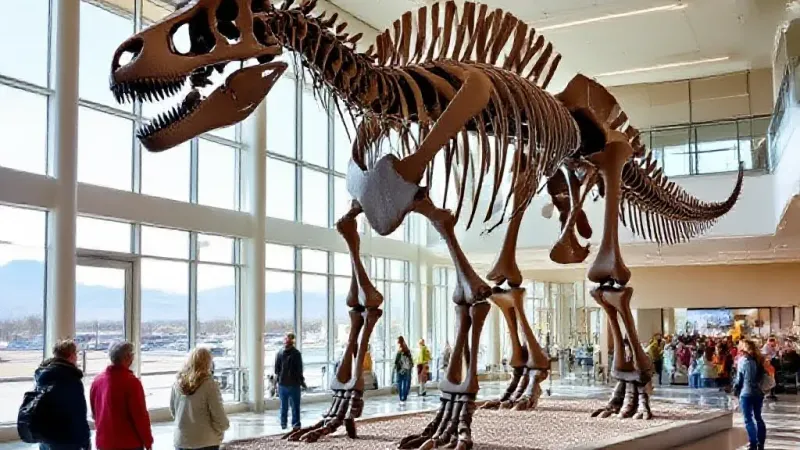
Grand Junction organizations are accelerating efforts to raise $850,000 for a 45-foot brachiosaurus fossil casting destined for the Grand Junction Regional Airport, with an ambitious goal to secure the necessary funding or a clear path to it by the end of this year.
The project aims to bring a casting of the brachiosaurus, first identified in the Grand Junction area in the early 1900s by paleontologist Elmer S. Riggs, back to the community. The casting will be made from the skeleton originally unearthed in the Redlands area. Organizers hope to complete the installation by 2028.
Jennie Aubert, who is spearheading the fundraising in coordination with the Grand Junction Regional Airport and the Museums of Western Colorado, confirmed the aggressive timeline. She noted that while not all grant money might be awarded by December, the groups want to “at least have an idea of what that forecast looks like” by the start of 2027.
So far, approximately $185,000 in pledges and donations have been committed to the cause, including $10,000 in small donations received through the museum’s website, according to Aubert. Future fundraising plans include a naming contest for the dinosaur, along with solicitations for various grants and philanthropic contributions, airport officials and Aubert stated.
The total $850,000 project budget includes an estimated $500,000 for the manufacturing of the fossil casting itself. An additional $150,000 is budgeted for the installation of the towering specimen at the airport, with another $200,000 allocated for its long-term maintenance and contingency expenses, Aubert detailed. Even once the funds are secured, the fabrication process for the casting alone is expected to take 18 months.
Once completed, the Museums of Western Colorado will own the fossil casting, but it will be on an indefinite loan to the Grand Junction Regional Airport. The airport is one of the few local buildings with ceilings high enough to accommodate the 45-foot-tall display. Airport CEO Angela Padalecki likened this arrangement to existing agreements for aircraft displays outside the terminal, which are maintained by airport personnel but owned by the National Naval Aviation Museum. Padalecki emphasized that the agreement would include language ensuring that if the museum’s ownership were to change, ownership of the dinosaur would revert to the airport, protecting what she called an “anchor piece of infrastructure.”
Plans for the brachiosaurus casting were first announced on August 1 during celebrations marking the 150th anniversary of Colorado’s statehood. This initiative pays homage to the original brachiosaurus discovery, whose bones — still the most complete brachiosaurus fossil unearthed to date — are housed at the Field Museum of Natural History in Chicago. Castings of these original bones are now owned by Triebold Paleontology, a Colorado company.
Museums of Western Colorado Paleontology Director Julia McHugh noted the challenge of telling the story of local dinosaurs when the original fossil is no longer in the area. She said the skeleton at the airport would facilitate expanded programming, serving as a “gateway to Grand Junction” and a “gateway to paleontology in our area.”