Federal water authorities do not intend to announce how much water can be released from Lake Powell and down the river to Lake Mead until April 2027. This assessment will consider winter snowpack, runoff forecasts, reservoir conditions, and other hydrologic data, according to Wayne Pullan, the Upper Colorado River Basin regional director for the U.S. Bureau of Reclamation. Pullan estimated that the eventual volume of release will be between 6 and 7 million acre-feet.
Pullan stated that protecting the infrastructure at Lake Powell, specifically keeping the hydropower at Glen Canyon Dam operational, is a high priority. This requires maintaining an elevation level of 3,510 feet above sea level. As of Monday, Lake Powell stood at 3,520 feet above sea level. The bureau is also responsible for protecting infrastructure across the entire Colorado River system, which will require the Lower Basin states of Arizona, California, and Nevada to take about 1.25 million acre-feet less water under previously announced guidelines. These three states have also agreed to voluntarily conserve an additional 700,000 acre-feet in Lake Mead over the next two years.
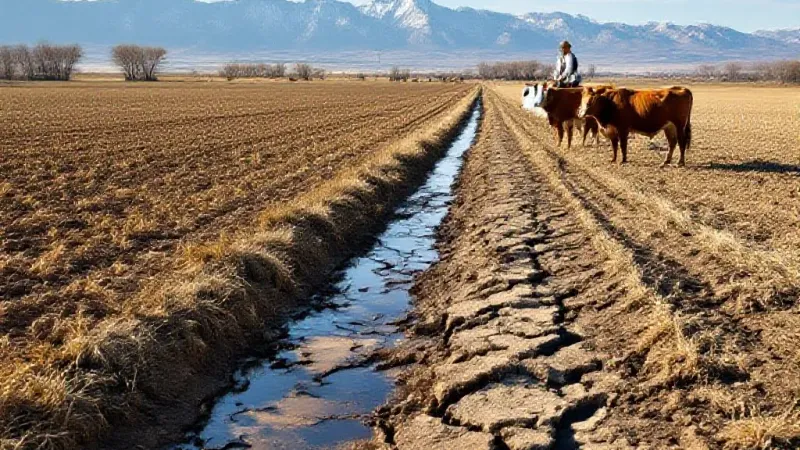
Colorado Commissioner Becky Mitchell, who chairs the Upper Colorado River Commission, reported that water users in Colorado face "unprecedented challenges" due to limited supply and strict regulations. She noted that water users in Colorado are "selling cows because they can’t feed them." In the Grand Valley, home to Palisade peaches, irrigation was cut off two months before the end of the irrigation season—the first time this has happened in 111 years. In the Uncompahgre Valley near Montrose, water users, including some with senior water rights, received only 50% of their normal allocations, leading to land being fallowed. The Ute Mountain Ute Farm and Ranch Enterprise received only 15% to 20% of their allocations.
Mitchell added that Colorado's storage buckets are "near empty." Blue Mesa Reservoir in Gunnison County, the state's largest, is below 20% capacity and is expected to be at or below minimum power pool soon, creating "ideal conditions for toxic algae growth." Northern Water, based in Loveland, reduced its Colorado River supplies to agricultural and municipal shareholders on the Front Range by 20%. The Frying Pan/Arkansas project in southeastern Colorado received only 1,000 acre-feet from their Colorado River allocations.
Commissioners from other states also reported severe conditions. Brandon Gebhart of Wyoming noted that his state typically irrigates about 300,000 acres with Colorado River water, but this was cut by 161,000 acres in the past water year. He said officials hope to advance a voluntary conservation program, available to all Upper Basin states, which comes with a $100 million federal grant. New Mexico Commissioner Tanya Trujillo reported her state experienced the worst hydrology on record in the past year, though September was also its wettest ever. Historic flooding in the San Juan River Basin in north-central New Mexico, which flows into Colorado and through Pagosa Springs, prompted Archuleta County to declare a local disaster emergency last month. Utah Commissioner Gene Shawcroft described 70% cuts in water deliveries in some parts of his state as "devastating," noting heavy rains also caused damage in southern Utah, particularly in burn scar areas.
Mitchell contrasted the situation in the Upper Basin with the Lower Basin states. She stated that while Upper Basin users "have not had a full supply" during drought years, partners in the Lower Basin "enjoyed full supplies and experienced only modest shortages for the first time in 2022." She also pointed out that the largest reservoir in the entire Colorado River system is now underground in Arizona, with the state having created about 15 million acre-feet and long-term storage credits in its underground aquifers since 1990. Mitchell urged the use of this stored water, saying, "The largest reservoir in the Colorado River system right now currently exists underground."
Regarding ongoing legal action, Mitchell commented on a lawsuit filed in August against the U.S. Department of the Interior by Nevada, now joined by Arizona, concerning new operating guidelines. She stated she does not believe the Nevada Federal District Court is "the right venue to interpret the law of the river" and that "This litigation will not provide one more drop of water."
Chuck Collum, the commission’s director, reported on current storage levels for other reservoirs. Flaming Gorge in northeastern Utah is 67% full, holding about 2.2 million acre-feet above its critical elevation of 5,871 feet above sea level. Navajo Reservoir, straddling the Colorado-New Mexico border, is approximately 53% full at 6,021 feet above sea level, which is above its critical elevation of 5,990 feet required for the Navajo Indian Irrigation Project.
The Upper Colorado River Commission has also initiated discussions on a new conservation program, evolving from previous system conservation pilot programs. This program, supported by a $100 million federal grant, aims to conserve water through agreements that compensate water users for voluntary and temporary reductions in their water use. Commissioners are currently reviewing the program’s guidelines and agreements.