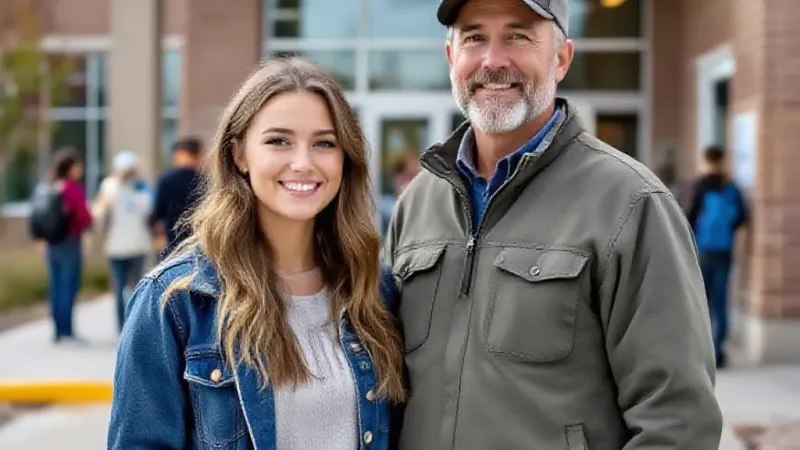
Grand Junction's Isabelle Harris, 19, and her father, Rob Harris, recently traveled to Washington, D.C., to advocate for federal funding and support for individuals with disabilities. Their mission focused on preserving the Individuals with Disabilities Education Act (IDEA) and its implementing federal office, sharing their lived experiences with lawmakers, and highlighting the importance of specialized instruction and access to adaptive technology and education.
Isabelle, a sixth-generation Western Slope native, said her primary goal was to ensure other blind people receive the necessary resources they currently lack. She aimed to meet with bureaucrats in person to ensure they truly understand and consider the realities of living with a disability in school and beyond. Her father, Rob, emphasized the need to show lawmakers how federal funding decisions directly impact individuals like Isabelle in western Colorado.
The Harrises sought to preserve IDEA, specifically advocating for Part D, which funds the infrastructure for expertise and capacity to provide services. They expressed concern over President Donald Trump’s 2027 budget proposal, which suggests folding Part D into Part B without requiring funds for Part D activities. A House budget draft, however, has proposed preserving Part D without a funding increase. The Harrises also aimed to illustrate the direct impacts of federal Medicaid changes approved in last year's One Big Beautiful Bill Act. Rob Harris stated that current Medicaid cuts directly impact his daughter, urging lawmakers to consider the real-world effects on individuals in western Colorado. Additionally, the father and daughter sought to advance Senate Bill 5046, which addresses transfers by the U.S. Department of Education.
Isabelle was born with optic nerve hypoplasia (ONH), a congenital condition where one or both optic nerves are underdeveloped. She is legally blind with 20/800 vision, meaning things 20 feet away appear as clear to her as objects 800 feet away do for a sighted person. ONH, the leading cause of blindness in U.S. children before age three, can also affect other aspects of brain development, leading to complications like epilepsy or delayed cognitive development. According to Isabelle and Rob, navigating medical and academic systems has been especially arduous due to a lack of education about ONH. Rob had to become an expert in Medicaid and its long-term support services to cover lifelong care that private insurance and personal wealth do not typically provide.
The Harrises also shared their struggles with the local public education system during Isabelle’s elementary and middle school years. Because Isabelle retained some usable vision, they said the district often attributed her challenges to cognitive or behavioral problems. Isabelle often needed extra time to process information, and her parents believed her vision was not adequately considered. While some successes were achieved, such as introductory braille training and instruction on using a cane, Rob stated that the district ultimately lacked the necessary financial resources, personnel, and experience with disability to fully support Isabelle.
Isabelle eventually transitioned to a homeschool model, which she said empowered her to master foundations she couldn't previously comprehend like her sighted peers. The difference, according to Isabelle and Rob, came from dedicated time, tactile learning tools, and braille literacy. Rob explained that simply providing audiobooks can miss critical nuances, like commas, which can change the whole context of a sentence and hinder true literacy. Simple yet creative tools, such as outlining maps with Wikki Stix (bendable wax yarn), helped Isabelle understand the actual shape and sizes of U.S. states. She also uses advanced technology, such as her Monarch device, a multi-line, refreshable braille and tactile graphics display for typing and translating virtually any document into braille. Rob noted that the one-on-one aspect of homeschooling was highly beneficial, especially when dealing with uncommon technology.
The Harrises' nearly two-decade journey taught them that "nothing improves without action, and action is only spurred by advocacy." Their trip to Washington centered on youth with disabilities self-advocating and sharing their stories about the impact of good support, what good community support requires, and the consequences when those supports are missing. Rob expressed hope for a nonpartisan approach to the issue, stating that their community-level solutions and personal stories can bridge political divisions.
Isabelle and Rob were joined by 11 other disability advocates during their trip, including two Ph.D.s and a pair of brothers who are blind and deaf, underscoring the collective effort to bring these issues to federal attention. They also hoped their trip would demonstrate to others with similar challenges the positive aspects of living with a disability and show what is possible.