
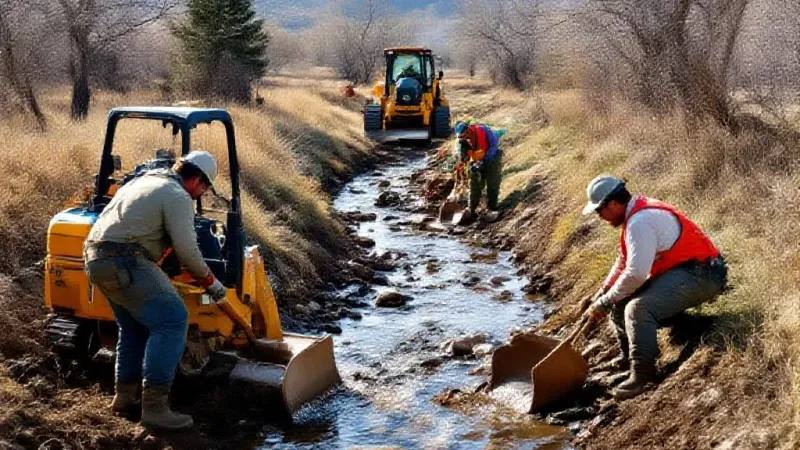
A stream restoration project on High Lonesome Ranch in Garfield and Mesa counties, nearing its third and final year, is one of the first to utilize a new 2023 state law designed to simplify such efforts. The Dry Fork Creek project aims to repair damage from the 2020 Pine Gulch Fire, which burned 95,000 acres, leading to significant erosion and debris flows into the valley bottom.
High Lonesome General Manager Travis Brooks said the flooding and debris were "a major impact to operations here," affecting wildlife habitat for years. He noted that the area’s recovery, including the return of wildlife and greening of the watershed, is partly due to the work done under the new legislation, Senate Bill 23-270. Brooks stated that the "devastation that comes after the fire is almost as bad as the fire itself, and we’re still seeing the effects of that," as the Pine Gulch Fire caused rainstorms to wash mud and rocks into Dry Fork Creek.
Colorado lawmakers passed SB 270 in 2023 to address the need for restoring environmentally healthy waterways, particularly after wildfires. The legislation allows minor stream restoration projects to proceed without extensive water rights administration, provided they meet specific criteria. However, this is new legal ground, and initial projects are already revealing long-standing disagreements between water rights holders and those advocating for stream restoration.
Audubon Rockies spearheaded the Dry Fork Creek project. Over three years, crews installed approximately 200 porous structures across two miles of stream. These structures, known as Post-Assisted Log Structures (PALS), are built by weaving willows and tree branches between posts hammered into the streambed. Their purpose is to trap sediment, slow water flow, raise the water table, and rewet the floodplain. These low-tech methods can transform deeply incised streams into wider, U-shaped streambeds and act as speed bumps during summer storms, improving watersheds degraded by fire, road building, and cattle grazing. Brooks believes the work is "improving the water quality out here," which benefits downstream users.
Abby Burk, Western Rivers program director for Audubon, explained that SB 23-270 allows six categories of minor stream restoration, such as stabilizing banks or reconstructing channels. Projects falling under these categories are presumed not to harm other water users, allowing quicker progress. Environmental groups initially sought a broader standard for restoration size, based on historical floodplains. However, agricultural water users and other opponents expressed concerns that larger projects could increase surface area for evaporation, reducing streamflows. In Colorado’s water law, older rights have priority, meaning water is often already allocated. Without SB 270, restoration proponents might face expensive processes to acquire augmentation plans.
The final bill was a compromise, requiring projects not to back up water past the "ordinary high-water mark" of the stream. Burk described the outcome as "an elegant compromise" that was unanimously supported. Jackie Corday, a natural resources consultant who worked on the bill and the Dry Fork Creek project, initially expressed disappointment but later recognized its potential to enable significant work.
As more groups adopt projects under SB 270, the legislation’s boundaries are being tested by potential conflicts with downstream water users. In late August, the National Forest Foundation and Roaring Fork Outdoor Volunteers initiated another restoration project in the White River National Forest, installing about 40 PALS in the headwaters of Middle Thompson Creek, a Crystal River tributary. This site was identified through a beaver inventory funded by Pitkin County and conducted by the U.S. Forest Service. Clay Ramey, a fisheries biologist with the White River National Forest, hopes the structures will encourage beavers to recolonize the site. The Forest Service plans a similar project next year in the headwaters of Four Mile Creek.
However, the proposed Four Mile Creek project’s size and scope have raised concerns from the Rifle-based West Divide Water Conservancy District. The district, which operates reservoirs and provides irrigation and augmentation water, believes the project could affect its water supply for a planned expansion of Martin Reservoirs. West Divide argues that the work might increase both the stream’s surface area, leading to more evaporation, and water consumption by wetland vegetation. In a January letter to state Division of Water Resources Division 5 Engineer Tyler Benton, the conservancy district stated that the 152 structures planned over three phases might exceed the scope allowed by SB 270. West Divide board member Chris Treese acknowledged the stream needs restoration but stated, "we don’t want those efforts to result in an impact to our water rights or any other water rights downstream."
Part of this disagreement stems from a lack of data on how these beaver-mimicking projects influence water movement in valley bottoms. Joel Sholtes, a water resources engineer and instructor at Colorado Mesa University, received a three-year, $15,000 grant from Pitkin County Healthy Rivers in August. He aims to study how beaver activity alters ecosystems in the North Thompson Creek area, using sites with beavers as reference points for comparison.