
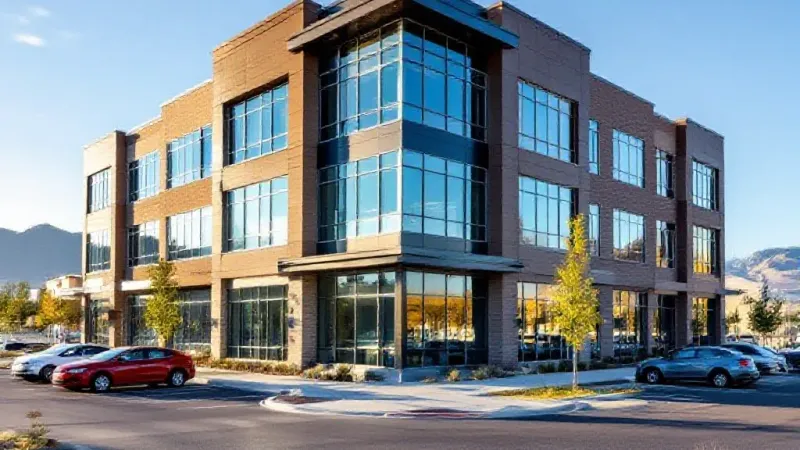
A startup focused on processing uranium waste is weighing Grand Junction as a potential site for its new headquarters, a move that could create 118 jobs in the area. DISA Uranium Corp. is considering either Grand Junction or Moab, Utah, for the facility.
On Thursday, the Colorado Economic Development Commission approved nearly $1.6 million in job growth incentive tax credits for the company. The project, submitted to the commission under the code name Project Curie, involves an estimated $2.25 million investment, according to The Denver Post. The Post also reported that the average annual wages for these jobs are projected to be $80,039, which is 139% of the average wage in Mesa County.
DISA's business model centers on treating uranium waste piles across the Four Corners region as valuable resources rather than environmental liabilities. This region has numerous abandoned uranium mine waste sites, a legacy of Cold War-era mining.
In 2025, the U.S. Nuclear Regulatory Commission (NRC) issued DISA a unique source materials license, SUA-1605. This license makes DISA the only company in the United States with a multi-site NRC license specifically for treating and recovering uranium from abandoned mine waste across multiple locations. The company initially applied for this license in March 2025.
This regulatory advantage was bolstered by a proposed transaction announced last August. DISA Technologies and IsoEnergy Ltd. agreed to form DISA Uranium Corporation, with IsoEnergy contributing its permitted, past-producing Utah mine portfolio and participating in $33 million in financing, as reported by World Nuclear News. IsoEnergy is slated to hold a 33% equity stake in the new entity. The agreement also included a $105 million private placement financing commitment from a group of international mining, energy, and venture firms, including Tembo Capital, BHP Ventures, and Galvanize Climate Solutions. This proposed transaction implied a pro forma equity valuation of approximately $505 million for DISA Uranium.
The Nuclear Regulatory Commission has also issued an Environmental Assessment and Finding of No Significant Impact for DISA's plan to process approximately 1,656 cubic meters of legacy waste at the Mary Ann abandoned uranium mine site in Montrose County. The NRC is currently considering approval of the associated Permit to Mine Notice (PMN). This project involves establishing a radiologically restricted processing zone and transporting processed materials off-site.
Just one day before the state tax credit vote, DISA Uranium signed a waste treatment agreement with Uranium American Resources, Inc. This agreement covers the processing of legacy waste at the Stateline Project, a cluster of over 19 historic uranium and vanadium mines spanning Montrose County, Colorado, and San Juan County, Utah, according to the Junior Mining Network. Under this agreement, Uranium American Resources will receive a revenue share from mineral sales while DISA remediates the property.
DISA's reclamation process uses its patented High-Pressure Slurry Ablation technology. This mechanical process involves particle collisions and differences in mineral hardness. Testing on Copper Mountain samples demonstrated that the technology concentrated 83.9% of uranium in 29.3% of the sample mass and 90.6% in 37.5% of the mass, Crux Investor reported.
The potential for cleanup is extensive, with more than 15,000 sites associated with abandoned uranium mine waste located throughout the western United States. Many of these sites are on or near tribal lands. The Environmental Protection Agency (EPA) and Navajo Nation EPA have conducted pilot studies using DISA's ablation technology at legacy mining locations, including Quivira Church Rock No. 1 and the Cove Transfer Station, to evaluate the removal of radium-226 and uranium from radioactive waste. Local communities and tribal authorities in the region are sensitive to legacy radiation risks and the transportation of waste.
The demand for uranium, which DISA aims to recover, is influenced by recent geopolitical shifts. The federal Prohibiting Russian Uranium Imports Act, effective August 2024, banned low-enriched uranium imports from Russia, which previously supplied nearly 20% to 25% of the enriched uranium used by U.S. commercial nuclear power reactors. This act also unlocked $2.72 billion in federal funding to expand domestic nuclear fuel supply chains, according to the U.S. Department of Energy. Nuclear power is experiencing renewed interest as electricity shortages, driven by data-center demand for artificial intelligence platforms, push utilities toward sources that The Denver Post describes as more reliable than solar and wind and carbon-emission-free.
DISA Uranium was not the only company to receive state incentives this week. The Colorado Economic Development Commission also approved up to approximately $2.7 million in job growth incentive tax credits for Project Otter, which expects to create 237 jobs at average annual wages of $184,135, or 270% of the El Paso County average. Additionally, the commission approved refundable tax credits for six television, film, and video game projects, including a $2 million incentive for "The God Pack," which plans filming along Colfax Avenue, Broadway, and at the National Western Center in Colorado.